The Great Fire of 1845
The Willamette Valley had become quite the settlement by the mid
1800's. There were fertile farm land, plentiful game, and plenty
of rain for crops. Legend has it that one of the new immigrants was
burning brush from his newly homesteaded land as the fire got out of hand.
Fanned by an unusually high easterly wind, it raced west into the Coast
Mountain Range. It consumed everything in it's path including old growth
timber that had stood for hundreds of years.
As the monstrous fire neared the coast, the local Indian population became under siege. It is
said the Nestugga Indian Tribe was camping on what is now the Big Nestucca
River near what is now called Woods. They were forced to paddle their dugouts
downstream in a panic, leaving all their possessions behind to find refuge
on the sand spit, now called Bob Straub Park. The fire desecrated
the land and the wildlife. For centuries the Indians had relied on
the large herds of elk, deer, and bear for sustenance. After the
catastrophe, their main staple became the fish from the rivers as the game
in the area was virtually eradicated.
By 1854, there were only a handful of settlers in the Tillamook Valley
and the only access from the Willamette Valley was over the very crude
Hebo Trail laid out by these early settlers. This trail ran from
Grand Ronde over Mt Hebo (originally called Mt. Heavo) to where Hebo is
today and then followed an old indian trail 20 miles to the Tillamook Valley.
Before the settlers began arriving to the Nestucca Valley in the 1870's, it was
populated by Indian Tribes of the Nestuggas and the Killamooks (note the
name origin of the Nestucca River and Tillamook). The original name
of Haystack Rock is said to be "Chief Kiawanda Rock" named after a very
well known Chief of the Nestugga Tribe from the early 1800's (note spelling
difference). By the time the Tribes were relocated from their homes to
a reservation on the Salmon and Siletz River, the Indians numbered around
200. Around 1876, Chief Nestugga Bill and the last of the small tribe,
paddled down the Little Nestucca River across the bar into the Pacific
Ocean and headed south to their new home.
It was along the Nestucca River that many of
the early pioneers came on sea going steamers such as The Della, The Elmore,
and The Gerald C.. These steamers frequented the rivers, bays, and
bars from San Francisco to Astoria. Other pioneers traveled over the mountains
by rough trails crossing many rivers with no bridges. In 1882, a
road from Grand Ronde to the Nestucca Valley was completed greatly improving
travel. Many descendants of the early settlers still
live in the area.
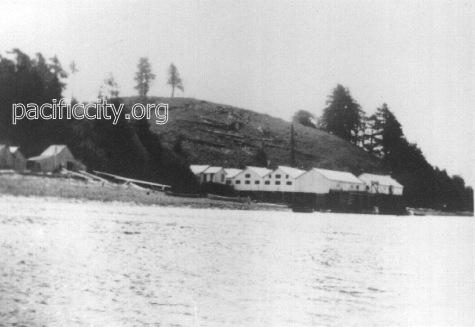
Because fish (salmon) were so plentiful in
the Nestucca Bay, a commercial cannery was built in 1886 by Linewebber
and Brown. It was located on the east side of the bay and thrived
for many years employing both Caucasian and Chinese workers. The cannery
canned and shipped 12,000 cans of salmon a year. The fishermen and
cannery workers both made a good living.
Fishing, Logging, and eventually Dairy Farming,
became the primary occupations in the valley. Because of the unique
location near both river and ocean, it became the focus of recreation.
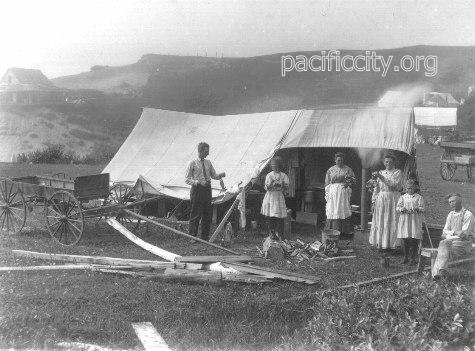
Early "vacationers" would brave the elements by buckboard and horseback
coming from the Willamette Valley to enjoy the Pacific Ocean and the river.
It was usually at least a 2 day trek. Many of these early resort seekers
had never seen the ocean having come from the midwest on the Oregon Trail.
Campgrounds and facilities soon sprang up to accommodate these travelers.
Originally called Ocean Park, the area was
homesteaded by Thomas Malaney who platted the town in 1893. It was
originally located across the river from Woods, which at the time had already
been established as a major depot and trading hub for supplies for the
settlers. Though Malaney and his brother had already sold some lots, a
flood covered the area in 1894 before any houses could be built much to
the chagrin of the lot owners. Malaney moved the town further south
to higher ground (where it is now) and gave new lots to the previous buyers.
The new town created competition for Woods who were not happy about the
new venture.
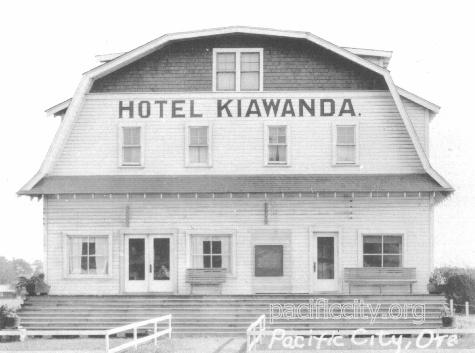
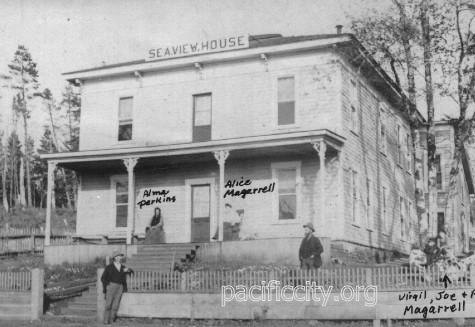
A hotel was built around 1895 called the Sea
View and later named the Edmundes Hotel. Visitors from the Willamette
Valley stayed at the hotel and nearby campgrounds. There was a fishing
dock, recreation hall (Dance Hall), and store along the river at the foot
of Ferry Road where a hand operated ferry would shuttle pedestrians, wagons,
buckboards, and eventually autos across the river to the ocean beach. A
wooden plank road was built down Ferry Street to keep the autos from becoming
stuck in the sand.
Kelp ore was discovered in 1904 by Thomas Brooten
(pronounced Brahton) who built a large compound to which patients from
all over the US (and some foreign countries) came for the healing properties
of the ore. The resort was later turned over to his son H.H. Brooten
who ran the business for many years. The sick would bathe in special baths,
apply it directly to the skin, or take it by mouth. There appeared
to be redeeming properties to the ore and it was used by many as a last
resort to heal their ailment. This helped put the area on the map (literally).
The famous Brooten Kelp Ore Resort flourished until it's peak during the
1920s when an outbreak of tuberculosis eventually closed the enterprise.
Because of confusion with another Ocean Park
in Washington, the name was changed in 1909 to Pacific City and a Post
Office was established. By 1910, a school was built attended by about
12 children the first year. A weekly publication called the "The
Pacific City Lookout" publicized the the ecstasy of living at the new resort
area. The town prospered and grew with many new businesses being established
to accommodate the growing number of visitors as well as the permanent
residents.
In 1926, with the once plentiful salmon population
dwindling, there was an outcry by non-commercial fishermen to stop the
unmanaged harvest. A state law was passed to close the bay and it's
tributaries to commercial fishing (still in effect today). This action
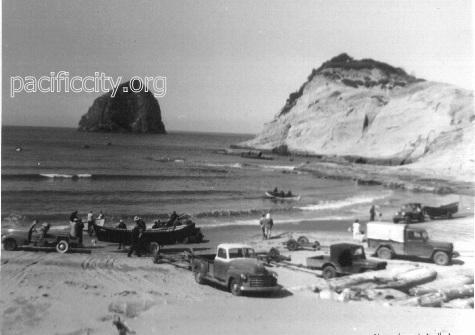
was instrumental in developing Pacific City's famous Dory Fleet who would
launch their double ended fishing boats off the beach into the surf.
Although in use during the early 1900's, the dories came into their own
now. Entering the open sea was dangerous when crossing the bar at
the mouth of the Nestucca Bay, so these hearty souls would battle the surf
to gain access to the salmon off shore. Pacific City is one of only
a couple dory surf launches on the west coast even today. The first
dories were launched into the surf by horses as well as motor vehicles.
During the 60's and 70's, the dory fleet numbered well into the several
hundreds whose catch were bought by several fish buying stations.
With larger commercial fishing vessels eventually supplying the demand
for salmon, the Dory Fleet has slowly dwindled to only a few today.
However, there are many of the old dories still being launched by recreational
fishermen keeping the tradition very much alive.
Pacific City prospered during the 20's through
good promotion being the closest and easiest access to the ocean from the
Willamette Valley. The Airport was built which attracted numerous
aviators and barnstormers. However, other roads were eventually opened
to the coast, and with the depression of the 30's (coupled with the new
fishing restrictions) the town suffered. However, the town recovered
somewhat as Brooten Road was built during the 30's allowing easier access
from the newly developing highway. A bridge was built across the
Big Nestucca for pedestrians and autos to reach the beach. The bridge
was designed and constructed so the planks could be removed during the
winter runoff preventing the bridge from being washed away. This
bridge has been replaced a couple of times over the years. Then,
during the 50's, the CCC crews were enlisted to plant Holland Grass on
the dunes thus stabilizing them for building homes. The State of
Oregon took over the operation of the airport and improved it substantially
attracting new interest. So many people moved to Pacific City from
the McMinnville area, they referred to their hillside homes as McMinnville
Heights. In 1960, the road to the sandlake junction was completed
making yet another avenue to travel and attracting yet more tourism.
By now, Pacific City had established itself as a vacation destination and
perfect get-a-way from what had become a busy Portland and Willamette Valley.
The annual salmon and steelhead run still bring sports fishermen from all
over the State (and the US for that matter). And, as it was over
a hundred years ago, the pristine beach is still irresistible for family
fun.
Many old timers in town, along with some long
time visitors, claim Pacific City has changed alot during the last 40 years.
However, compared to other coastal towns, it remains a relatively undeveloped
quaint village and has retained everything that originally attracted early
settlers and visitors. Pacific City is still unincorporated and has
no mayor or city council. Bordered on three sides by BLM land, and
the Pacific Ocean on the forth, further development of the area will be
greatly restricted.
Progress is slower today than it was a hundred years ago....
Pacific City has a long history and a bright future....
Want more history? Check out Pacific City Library History
|
|